Jameson Williams & More 2026 Fantasy Draft Targets Based On Utilization Report Game Log Data
Adam Pfeifer runs through three cases where the Utilization Report Game Log helps highlight trends from last season that position three players as targets in 2026 fantasy football drafts.
The Utilization Report is the greatest tool in the history of fantasy football.
Sorry. I don’t make the rules.
But seriously. Usage and playing time are arguably the two most important aspects of analyzing our beloved game, and the Utilization Report encapsulates both perfectly. I basically get lost in the sea of data every single day, so why not write about what stands out?
Over the next few weeks, we’ll be highlighting different aspects of the Utilization Report, breaking down key fantasy takeaways that we can apply for 2026. First up is the game logs page, which allows you to sort a ton of utilization by given timeframes. Because knowing why something happened is far more important than simply acknowledging that it did.
Let’s go.

Join Our Newsletter
Trusted by 400,000+ fantasy football players. Get access to Fantasy Life's free award winning newsletter and tools, all in one step.
By registering or logging in, you agree to our Terms of Use and Privacy Policy.
Key Takeaways From The Utilization Report Game Logs To Apply To 2026 Fantasy Football
 Jameson Williams’ Second Half Usage
Williams is one of the more interesting players in all of fantasy. One week, he’ll go for 150 yards and a touchdown on four catches, propelling you to a victory. And the next? Two catches, 21 yards on three targets.
Boom, meet bust.
More often than not, the week-winning upside is too tantalizing to bench, but his non-existent floor also made Williams a risky start. But there was a stretch last season when Williams was a much, much more consistent producer, while still presenting that 25-plus point upside.
Week 10 was a pivotal point in the fantasy season for the Detroit Lions, as it was the first game that HC Dan Campbell took over playcalling duties. Williams wasted no time making an impact, hauling in six passes for 119 yards and a touchdown against Washington. All of his Utilization Report metrics were much, much more favorable from Week 10 on. Take a look:
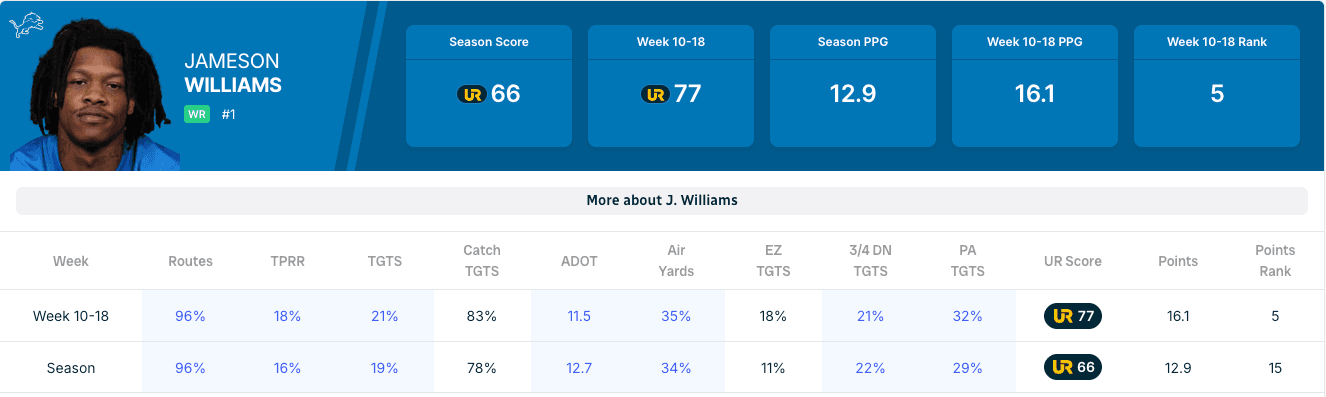
As you can see, target share, TPRR, end zone target share and play-action targets all increased for Williams from Weeks 10-18. I’d like to believe that the change in play calling would have given Williams a boost regardless, but at the same time, it’s difficult to ignore who was catching passes for the Lions during that stretch.
Or perhaps more importantly, who wasn’t.
That Week 10 game against Washington was the first with Campbell calling plays, but the last from tight end Sam LaPorta. He suffered a back injury, was placed on injured reserve and was sidelined the rest of the way. LaPorta’s absence clearly impacted Williams’ volume, who was targeted on just 14.7% of his routes with LaPorta on the field last year, a number that climbed to 19% with the tight end off the field. Williams averaged 7.3 targets per game from Week 10 on, up from his 4.5 per game from Weeks 1-9. During the final nine games of the year, Williams saw at least seven targets in seven of them. He had a 10-target game on Thanksgiving, catching seven balls for 144 yards and a score, but that was the game in which Amon-Ra St. Brown suffered an ankle sprain early on, leaving after just two routes.
So what does this all mean for 2026?
LaPorta will be back, plus the Lions have a new playcaller in Drew Petzing, who has historically featured the tight end position. Of course, Williams has improved each year, while his second-half usage featured an uptick in post routes, especially off play-action, which could remain a staple this season. From Weeks 10-18, no wideout in football ran more post routes than Williams, who saw his rate jump from 9.6% in the first half to nearly 16% in the second half. It is entirely possible that Campbell and the Lions had plans to feature Williams more in the second half of the year, regardless of LaPorta’s status. But it’s also tough to ignore how much his absence helped.
There’s plenty of reason to be excited about Williams, but I’m still viewing him as a high-end WR3.
 Emeka Egbuka’s Slump
If his NFL debut was any indication, Egbuka was set to have a rookie season for the history books. Four catches, 67 yards and a pair of touchdowns had Egbuka off to a stellar start, and he went on to score three more times over the next four weeks, averaging 94.5 yards per game during that span. Through the first five weeks, Egbuka was averaging 20.4 PPR PPG, good for the WR3 in fantasy. Everything was great.
And then Week 6 happened.
Egbuka suffered a hamstring injury in the second half, limiting him to just 64% of the routes. It sure sounded and looked like a multi-week absence, but Egbuka didn’t miss a single game. However, his production and efficiency from then on plummeted, leading most to believe he was far from fully healthy.
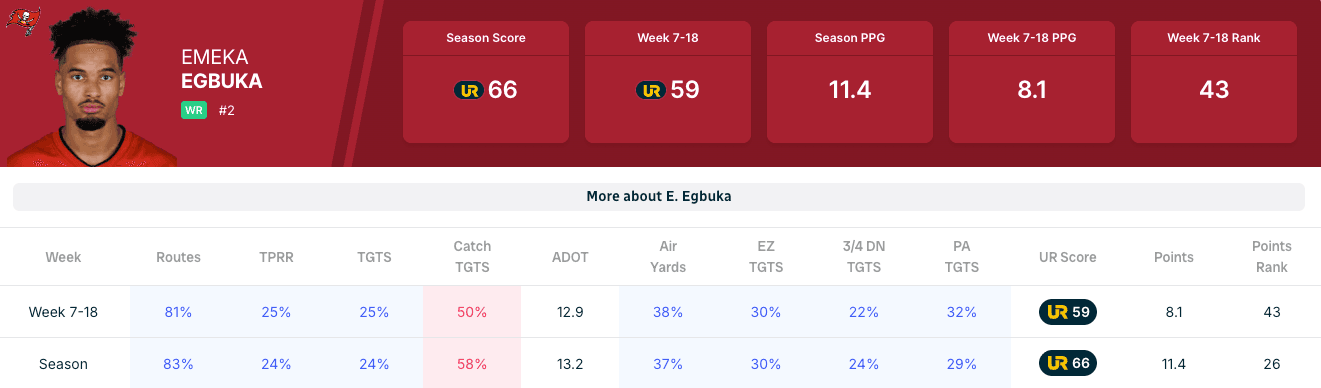
As the Utilization Game Log shows, Egbuka wasn’t close to the same player during the second half of the year. He was outside the top-40 wideouts in fantasy points per game, as both his playing time and efficiency took a hit. It’s very possible the hamstring issue sapped a lot of his ability the rest of the way.
Weeks 1-5 | Weeks 7-18 | |
|---|---|---|
| YPRR | 2.50 (13th) | 1.40 (61st) |
| YAC/Rec | 5.9 (9th) | 5.0 (16th) |
| Yards/Catch | 17.8 (4th) | 13.0 (32nd) |
The injury was tough, but it wasn’t the only contributing factor to Egbuka’s slumping second half.
Dwain McFarland highlighted Egbuka in his bounceback candidates article, pointing out how much his usage declined once Tampa Bay’s wide receiver room was fully intact. Chris Godwin returned in Week 12, while both Mike Evans and Jalen McMillan were back in the lineup in Week 15. From Week 12 on, Egbuka ran a route on just 74% of dropbacks, compared to 89% during Weeks 1-11. Egbuka wasn’t likely 100% healthy, and Tampa Bay’s receiver room was deep, making it understandable to see the dip in playing time. But Egbuka wasn’t the only player banged up to end the season.
So was his quarterback.
Baker Mayfield battled through multiple issues last year, most notably a shoulder sprain he suffered in Week 12. From then on, Mayfied also struggled, which obviously impacted Egbuka. From Weeks 13-18, just 51% of Ebuka’s targets were deemed catchable, an incredibly low rate. During Egbuka’s hot start, Weeks 1-5, however, that catchable target rate was at 76%. Mayfield was playing at an MVP level before the injuries began to pile up, so a healthy Baker could have Egbuka cooking once again.
 The Chargers OL Craters
Los Angeles’ season took a major hit before it even began, losing LT Rashawn Slater for the year. It was a nightmare start for the Chargers' offensive line.
They wouldn’t wake up from it.
After missing three games with a high ankle sprain, RT Joe Alt injured his right ankle again in Week 9, ending his season. Suddenly, the Chargers weren’t just missing their starting tackles, but two of the best tackles in all of football, and it had massive implications on, well, everything. In particular, let’s look at the final 10 weeks of the Chargers' season to see just how impactful Alt’s absence was on the team’s fantasy stars.
Of course, missing both starting tackles is obviously going to have the most notable impact on Justin Herbert, who was under constant duress last season. From Week 10 on, the Chargers were pressured on 44.1% of dropbacks, the third-highest rate in the NFL. In particular, Herbert was sacked 12.2% of the time during that span, the second-highest rate among all quarterbacks. Life without Alt was a struggle for Herbert, who averaged just 14.1 fantasy points per game during the final 10 weeks of the season. And over the course of the season, Herbert’s numbers really took a hit when Alt wasn’t protecting his blind side.
Alt On Field | Alt Off Field | |
|---|---|---|
| Comp. % | 67.5% | 65.9% |
| Yards/Att | 8.3 | 6.9 |
| TD Rate | 7.1% | 4.2% |
| FPts per DB | 0.55 | 0.42 |
Getting both Slater and Alt to protect Herbert is going to go a long way in his return to elite fantasy status, which, in the process, will vastly help Ladd McConkey bounce back from a sophomore slump.
After posting nearly 1,200 yards and seven touchdowns as a rookie, McConkey took a huge step back last season, hauling in just 66 of his 106 targets for 789 yards and six scores. The target share fell by about 3%, but it was the efficiency that really plummeted, especially once Alt was shut down for the season ahead of Week 10.
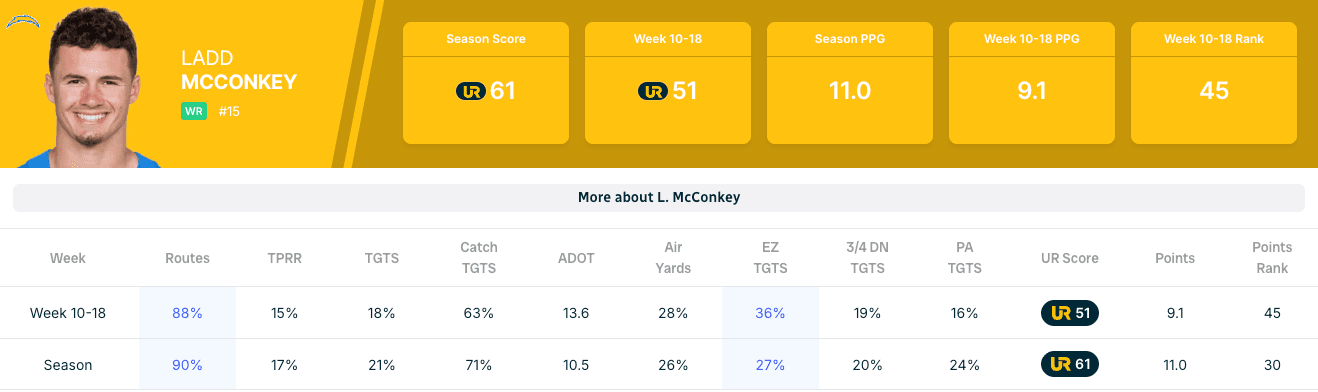
The addition of Keenan Allen hurt McConkey’s fantasy production early in the year, and that only intensified when the Chargers' offensive line was depleted. Because Allen’s aDOT during the final 10 weeks was 7.2 (11th-lowest), he was often the first read for Herbert when he was immediately under duress. McConkey, meanwhile, actually saw his aDOT climb to 13.5 yards during the second half of the season, which made efficiency a lot more difficult to come by, especially when your quarterback is being pressured between one and two seconds from the snap over 10% of the time. As a result, his TPRR, target share, catchable target rate and fantasy points per game all plummeted from Week 10 on, while his 12.53 air yards per target during that span cruised past his 8.72 mark from Weeks 1-9.
McConkey was being used downfield a lot more, which are already lower-percentage looks. But in this iteration of the Chargers offense, they might as well have been a Hail Mary.
Looking ahead to the 2026 season, a bounceback is on the horizon for McConkey. For starters, Slater and Alt being healthy simply makes everything easier for everyone in this offense. With Alt on the field, McConkey was targeted on 21% of his routes, and this upcoming season, we could easily see more schemed looks for the third-year wideout.
The importance of the Chargers adding Mike McDaniel as their new offensive coordinator cannot be overstated. He’s that impactful for fantasy football. Pre-snap motion and play-action are conducive to fantasy scoring, both of which should now be on the rise in Los Angeles. During McDaniel’s tenure in Miami, the Dolphins ranked first, second, first and first in shift-motion rate, averaging out to 73.5% during that stretch. The Chargers, meanwhile, utilized motion 50% of the time last year, the 20th-highest rate in football. Last year, McConkey saw just 13 targets from motion, which ranked 33rd among all wideouts, seven fewer than teammate Keenan Allen. For reference, Malik Washington had 18 such targets with McDaniel in Miami last season. And as long as Allen doesn’t return, those schemed layups should be designed for McConkey. Think Ladd in the Tyreek Hill role, Quentin Johnston as Jaylen Waddle.
McConkey’s sophomore year was a serious disappointment. But don’t let it discourage you from going right back to the well in 2026.
Join Our Newsletter
Trusted by 400,000+ fantasy football players. Get access to Fantasy Life's free award winning newsletter and tools, all in one step.
By registering or logging in, you agree to our Terms of Use and Privacy Policy.
Players Mentioned in this Article


Published Updated